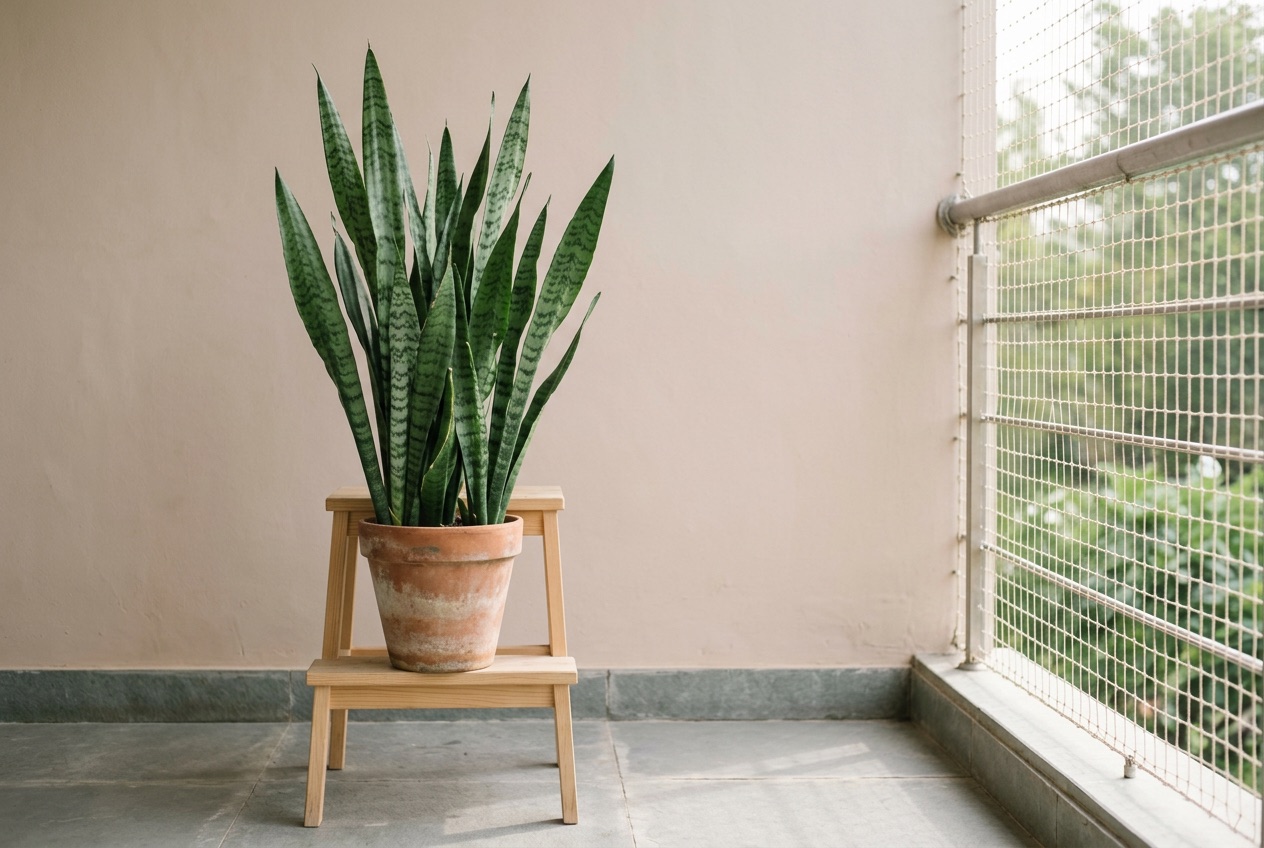
Snake plants (Dracaena trifasciata) need bright indirect light, watering only when soil is bone-dry, and fast-draining cactus mix in pots with drainage holes. They tolerate low light and weeks of drought, which makes them forgiving for beginners, but they die quickly if overwatered or left in soggy soil.
This guide covers the method for each care factor, not invented schedules. The evidence base for snake plant care is thin compared to commercial crops—most extension factsheets give categorical ratings like "Water: Medium" rather than measurements—so where the literature is silent, this post says so plainly.
Light Requirements
Snake plants perform best in bright indirect light, meaning a spot near an east or west window where direct sun doesn't hit the leaves for more than an hour or two. According to NC State Extension, they tolerate low light but grow slowly and may lose variegation in deep shade. The Missouri Botanical Garden rates light needs as "Part Shade to Full Shade", which in houseplant terms means anything from a north window to several feet back from a south window.
Direct sun outdoors or through unobstructed glass can scorch leaves, causing brown patches or bleached streaks. If you're moving a plant from low light to brighter conditions, do it gradually over a week to avoid shock.
Can snake plants live in windowless rooms? Yes, for months at a time, but growth stops and leaves may fade. Rotating the plant to brighter light every few months keeps it healthier long-term.
Watering Method and Frequency
The only published watering interval for Dracaena trifasciata comes from NC State Extension: "In winter only water every one to two months." That's it. No authoritative source gives a growing-season number because the interval depends on light intensity, temperature, pot size and material, soil composition, and plant size. Every "water every 2–3 weeks" on the internet is either invented or copied from something invented.
The method that works: water only when soil is completely dry throughout the pot. Check by lifting the pot (dry soil is noticeably lighter) or pushing a wooden skewer or your finger two inches down—if any moisture clings, wait. When you do water, drench the soil until water runs from the drainage holes, then empty the saucer. Never let the pot sit in standing water.
Signs of thirst: leaves wrinkle slightly or curl inward at the edges. Signs of overwatering: leaves turn yellow and mushy at the base, often with a rotting smell. Underwatering is recoverable; overwatering usually means root rot, which kills the plant.
The pot weight method is more reliable than any calendar. How often you'll actually water depends entirely on your conditions, which is why no honest source publishes a watering interval.
Soil and Potting
Use a fast-draining mix—cactus/succulent soil or the RHS mix of two parts peat-free loam-based compost to one part horticultural grit or fine gravel. Snake plants are succulents (they store water in their leaves) and their roots rot in moisture-retentive mixes. The RHS recommends "loam-based or loam-free potting compost" with added grit for drainage.
Terracotta pots dry faster than plastic or glazed ceramic, which helps prevent overwatering. Always use a pot with drainage holes. Snake plants tolerate being rootbound and do not need repotting on a schedule — and a crowded pot is one of the conditions under which a mature plant occasionally throws a flower spike. The RHS gives a condition rather than an interval: repot only once the roots and leaves have completely filled the container, or are causing it to buckle. These plants prefer a cosy-fitting pot.
Pot size: choose a pot only 1–2 inches wider than the root ball. Oversized pots hold excess moisture and increase rot risk, a common mistake Reddit users report after transplanting.
Temperature and Humidity
Snake plants prefer 15–27°C (60–80°F) and tolerate dry indoor air without issue. NC State Extension lists the outdoor hardiness range as USDA zones 9–11, meaning they can't survive frost. Bring outdoor plants inside before temperatures drop below 10°C (50°F).
They don't need humidity trays, misting, or any special moisture in the air. This is one of the few houseplants that thrives in heated homes during winter.
Fertilising
Feed sparingly, in the growing season only, at less than the strength on the bottle. No authoritative source publishes a fertilising schedule for D. trifasciata. The ones circulating online are invented. Excess fertiliser is a real failure mode here — it shows up as brown leaf tips and salt crusting on the pot — so the error worth avoiding is feeding too much, not too little.
If you haven't fertilised in over a year and growth has stopped, a single spring feeding may help, but don't assume fertiliser fixes every problem—overwatering and low light are far more common causes of poor growth.
Coffee grounds, rice water, sugar water: no evidence supports these. Plants make their own sugars through photosynthesis. Coffee grounds alter soil pH unpredictably and rice water adds starches that can encourage mould. Stick to tested fertilisers or none at all.
Propagation
Snake plants propagate easily from leaf cuttings or by division. For leaf cuttings, the RHS method is to slice a mature leaf widthways into 5cm (2in) sections, keep them the same way up as they grew, and leave them a day or two in a dry place so the cuts callus over before planting them half their depth. No source we trust publishes how long rooting takes — expect it to be slow. Variegated cultivars lose their stripes this way and revert to plain green. A peer-reviewed study in PMC documents organogenesis from leaf segments.
Division preserves variegation. Unpot the plant, separate rooted offsets (pups) with a clean knife, and repot each section. This is faster and more reliable than leaf cuttings for named cultivars. Both routes, and the mistakes that cost a season, are worked through in how to propagate a snake plant.
Common Problems
Brown Leaf Tips
Brown tips are usually caused by inconsistent watering—letting soil dry completely for too long, then soaking it—or by over-fertilising, which causes salt accumulation. Clemson HGIC describes tip burn in Dracaena species as a response to soluble salts and fluoride, but the fluoride claim is complicated.
The fluoride question: The PNW Handbooks entry on Dracaena tip burn names D. deremensis and D. fragrans as fluoride-sensitive species. Dracaena trifasciata only entered the genus Dracaena in 2017 (previously Sansevieria), and that literature predates the transfer. No source tests snake plant specifically for fluoride sensitivity. Uneven watering and fertiliser salts are better-supported causes.
If you suspect water quality issues, flush the pot thoroughly with distilled water every few months or use rainwater.
Yellow, Mushy Leaves
This is root rot from overwatering. If only one or two leaves are affected, cut them at the base with a sterile knife and let the soil dry completely before watering again. If multiple leaves are soft and the plant smells rotten, unpot it, trim away black or mushy roots, repot in fresh dry mix, and water sparingly. That is the summary; diagnosing and saving a plant already collapsing covers how far the rot has to go before the plant is past saving.
Leaves Falling Over or Leaning
Healthy snake plant leaves stand upright. Leaves that flop or lean usually mean one of three things:
- Overwatering: waterlogged roots can't support the leaves. Check for rot.
- Low light: leaves grow thin and weak in deep shade. Move to brighter indirect light.
- Physical damage: leaves broken at the base won't stand up. Cut damaged leaves off cleanly.
If the plant is rootbound and top-heavy, it may tip over—repot into a slightly larger, heavier pot.
Slow or No Growth
Snake plants grow slowly even in good conditions—a few new leaves per year is normal. If there's been no growth for over a year, the likely causes are low light, cold temperatures, or the plant being pot-bound. Moving to brighter light usually restarts growth within a season.
Leggy, Stretched Growth
Leaves that come up thin, floppy and unusually tall are etiolated — the plant reaching for light it cannot find. It is the most common shape complaint, and the answer is unwelcome: a stretched leaf never becomes compact again. There is no feed, prune or trick that thickens tissue already formed.
What you can do is change the conditions and let the plant grow its way out of it. Move it somewhere brighter — the Missouri Botanical Garden rates this species for part shade, which indoors means the brightest position you have short of hot midday glass. New leaves that emerge afterwards come in at the correct proportions, so the plant fixes its own appearance over time.
Once there are a few good new leaves, cut the worst of the stretched ones off at soil level. Remove them gradually rather than all at once: they are still feeding the plant while it rebuilds.
Making a Snake Plant Thicker
A "thicker" snake plant means more leaves growing from the base, which happens when the rhizome produces new offsets (pups). Higher light is the main driver—plants in bright indirect light produce pups more readily than those in low light. Density comes from new shoots, not from existing leaves widening by providing strong light, occasional fertiliser during the growing season, and allowing it to become slightly rootbound, which growers widely report brings on pups — though we have found no controlled work testing it.
Division is the fastest route to a fuller pot: unpot the plant, separate rooted pups, and replant multiple divisions together in one container.
Popular Cultivars and Varieties
NC State Extension lists several cultivars worth seeking out:
- 'Laurentii': the classic yellow-edged form, most common in garden centres
- 'Moonshine': pale silvery-green leaves with minimal variegation
- 'Black Gold': dark green with narrow yellow margins
- 'Hahnii': dwarf rosette form, stays under 30 cm tall
- 'Bantel's Sensation': narrow white vertical stripes
Variegated forms must be propagated by division to retain their patterns — leaf cuttings revert to plain green.
One name you will see sold alongside these is worth separating out: the cylindrical, sometimes braided "snake plant" is Dracaena angolensis (formerly Sansevieria cylindrica), a different species rather than a cultivar of this one — the accepted names are separate records at World Flora Online and Kew. Care overlaps closely, but it is not what this guide is about.
Indoor vs Outdoor Care
Snake plants can live outdoors year-round in USDA zones 9–11 (frost-free climates). In cooler regions, treat them as seasonal outdoor plants: move them outside after the last frost and bring them in before temperatures drop below 10°C (50°F). Outdoor plants need partial shade—full sun can scorch leaves.
Water outdoor plants more frequently than indoor ones, especially in hot weather, but still let soil dry between waterings. The NC State Extension page notes outdoor plants tolerate "some drought" once established.
In frost-free climates, snake plants work well as low-maintenance landscape plants for dry borders, rock gardens, or as architectural accents. They spread slowly via rhizomes and can form dense clumps over several years. In Florida, D. trifasciata has shown invasive tendencies in some natural areas, so check local guidance before planting outdoors in zone 9 or warmer.
Beginner-Friendliness, Honestly
Yes. It's one of the most forgiving houseplants because it tolerates low light, irregular watering, and dry air. The main way beginners kill it is by watering too often or using pots without drainage. If you can resist the urge to water weekly and check soil dryness first, snake plants are nearly unkillable.
Pet Safety
Snake plants are toxic to cats and dogs. The ASPCA lists Dracaena trifasciata as containing saponins, which cause nausea, vomiting, and diarrhoea if ingested. Keep them out of reach of pets that chew plants. They are not safe for human consumption either.
Snake Plants and Negative Energy
Some feng shui and folk traditions hold that snake plants remove negative energy or bring protective qualities to a home. These are cultural beliefs, not measurable effects. If placing a snake plant in a particular spot makes your space feel better to you, that's a valid reason to do it—but it's about your response to the plant's presence, not any metaphysical property of the plant itself.
How Many Plants a Room Needs
From a care perspective, as many as you have light and space for—they don't compete with each other. The idea that houseplants meaningfully purify indoor air is a popular belief stemming from older lab-based studies conducted in sealed chambers. The effect is routinely overstated, and the gap between the popular claim and the evidence is wide enough to need its own entry rather than a paragraph here. Snake plants produce oxygen at night (CAM photosynthesis), but one plant won't measurably change your bedroom's air quality. Grow them because you like them, not for air purification.
Lifespan
Snake plants live for decades with basic care. Individual leaves last several years before naturally dying back from the base, and the plant continuously produces new growth from rhizomes. There's no defined lifespan—plants can be divided and propagated indefinitely.
What Actually Makes One Thrive
Bright indirect light, watering only when soil is completely dry, well-draining soil, and temperatures above 15°C. That's it. They don't need fussing, frequent repotting, or special products. The best thing you can do for a snake plant is leave it alone between waterings.