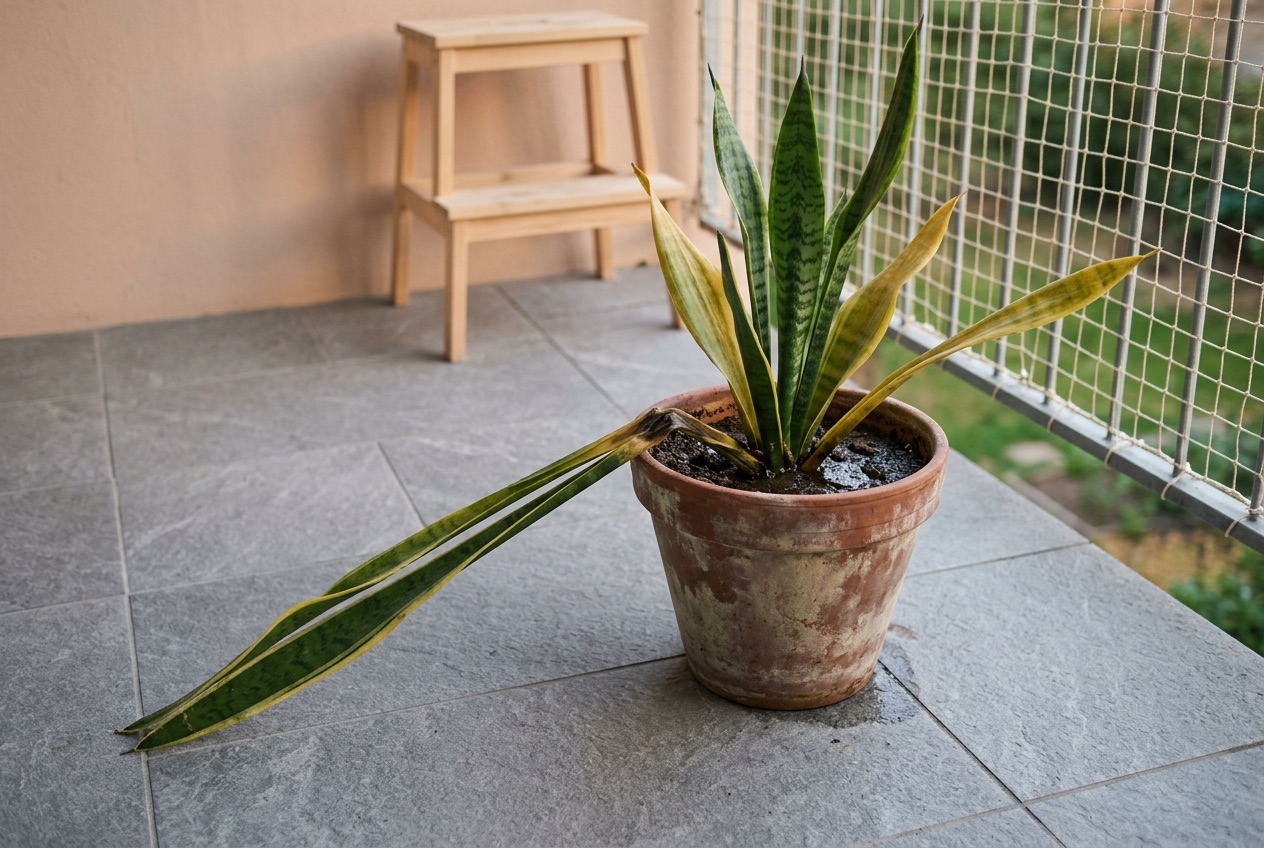
Your snake plant is dying because you're watering it too often. That's the most common cause by a wide margin, and it's counterintuitive — most people assume a struggling plant needs more care, not less. The second most common cause is root rot that began months ago and only now shows symptoms in the leaves. Both are fixable if you catch them before the entire root system turns to mush.
The good news: Dracaena trifasciata is famously resilient. Even plants with extensive rot can often be saved by cutting away damage, drying out the roots, and replanting in fast-draining soil. The bad news: yellow leaves won't turn green again, and mushy stems won't firm up. You're managing forward from the damage that's already done.
What a Dying Snake Plant Actually Looks Like
You'll see one or more of these symptoms:
- Yellow leaves, usually starting at the base, often mushy or translucent
- Brown, mushy stems that collapse when squeezed
- Wrinkled, curling leaves that feel thin or papery
- Foul smell from the soil or roots
- Brown tips on otherwise healthy leaves
- Leaves falling over or drooping at the base
The NC State Extension entry for Dracaena trifasciata lists root rot, leaf spot and tip burn as the primary problems. Root rot causes the first four symptoms above. Tip burn causes brown tips but not yellowing. Leaf spot (fungal or bacterial) is rare indoors and presents as distinct brown lesions, not generalised yellowing.
Yellow leaves don't always mean a plant is dying. A single old leaf yellowing at the base is normal senescence. But multiple yellow leaves, especially if they're soft or progressing quickly, signal overwatering or root rot — problems that will kill the plant if not addressed.
How to Tell If It's Overwatering or Underwatering
Overwatering causes yellow leaves that feel soft or mushy, often starting at the soil line. The soil stays wet for weeks. Roots are black, brown or translucent, and they smell bad. This is the overwhelmingly common scenario in online plant clinic forums.
Underwatering causes leaves that wrinkle, curl inward, or feel thin and papery. The soil is bone-dry and may have pulled away from the pot sides. Roots are white or tan and firm, just very dry. The leaves stay green or grey-green, not yellow.
If you're not sure, unpot the plant. Healthy roots are white to light tan and firm. Rotted roots are dark, slimy, and fall apart when touched. The RHS growing guide for Sansevieria emphasises that these plants "dislike overwatering" and need "free-draining compost."
One Reddit user on r/IndoorGarden admitted: "I watered it everyday. And when I noticed it dying I thought it didn't get enough sun and put it under sun behind glass." That's the classic error — more of everything when the plant needed less water and time to dry.
How to Save a Snake Plant from Root Rot
Root rot will not cure itself. The affected tissue is dead and must be physically removed to stop the decay from spreading. Root rot is a physical problem, not a disease you can spray away. Your goal is to remove dead tissue, dry out what's left, and give the plant conditions where healthy roots can regrow.
Step 1: Unpot and Inspect
Remove the plant from its pot. Shake or rinse off the soil so you can see the roots clearly. Smell them — rot has a distinctive sour or sulphurous odour.
Step 2: Cut Away All Rot
Use clean scissors or a knife. Cut off any roots that are black, brown, mushy or smell bad. Cut stems back to firm, green tissue. If a leaf is yellow or mushy at the base, remove the entire leaf. The Clemson HGIC factsheet on Dracaena notes that "root rot diseases" are the primary issue with overwatered specimens.
If you're left with no roots but the leaves are still firm, the plant can survive. Snake plants can regrow roots from leaf cuttings.
Step 3: Let It Dry
Set the plant on a towel or newspaper in a warm, airy spot. Let the cut surfaces dry and callous for 24–48 hours. This reduces the chance of new rot starting when you replant.
You will see hydrogen peroxide recommended constantly for this, usually as a dip for the cut surfaces. We have not found it supported by any of the horticultural authorities in our source list, and we are not going to invent a concentration for you. What those sources do agree on is drainage and drying. Do that part properly and the peroxide question stops mattering.
Step 4: Replant in Fast-Draining Soil
The RHS recommends a free-draining, peat-free cactus compost, or a mix of two parts peat-free loam-based compost to one part horticultural grit or fine gravel. A bagged cactus mix is the simplest route. What matters is that water runs through rather than sitting: avoid moisture-retaining peat or coir unless it is heavily cut with grit.
The pot must have drainage holes, and it should be only slightly larger than the root mass that survived. A plant sitting in a pot much wider than its roots holds wet soil the roots never reach, for weeks — which is the condition you are trying to escape. Step down a pot size after cutting away rot. No source states this as a rule, but it follows directly from what they do say: the RHS has these plants preferring a cosy-fitting pot and warns that compost which stays damp encourages root rot. The RHS specifies free-draining compost for this genus for the same reason.
Step 5: Don't Water Immediately
Wait at least a week, ideally two, before watering. The plant is in survival mode and doesn't need water yet. When you do water, soak thoroughly until water runs out the drainage holes, then let it dry completely before the next watering.
How to Revive an Underwatered Snake Plant
This is straightforward: water it thoroughly. Fill a sink or basin, submerge the pot, and let it soak for 10–15 minutes until air bubbles stop rising. Drain completely.
The leaves may take days or weeks to firm up. If they've been wrinkled for months, they may not fully recover their shape, but new growth will be healthy. The Missouri Botanical Garden Plant Finder entry rates snake plant drought tolerance as high, so even severe drying rarely kills the plant outright.
Should You Cut Off Yellow or Brown Leaves?
Yellow leaves: Yes, remove them. They won't turn green again, and they're a drain on the plant's resources. Cut at the base with clean scissors.
Brown tips: This is cosmetic. You can trim the brown part with scissors (cut at an angle to mimic the natural leaf shape), or leave it. The PNW Handbooks entry on Dracaena tip burn lists fluoride, soluble salts, and low humidity as causes, but for D. trifasciata specifically, the more common causes are inconsistent watering (letting the soil get too dry between waterings) and over-fertilising.
Contrary to widespread claims, snake plant is not listed as fluoride-sensitive. The PNW literature names D. deremensis and D. fragrans. Snake plant only entered Dracaena in 2017, and that fluoride research predates the transfer.
Drooping leaves: If the leaf is mushy at the base, remove it entirely. If it's firm but leaning, you can stake it or leave it — it won't straighten on its own, but it's not harming the plant.
What About Propagating from a Dying Plant?
If the plant is too far gone to save as a whole, you can propagate from healthy leaves. The RHS method is to cut a mature leaf off at the base and slice it widthways into 5cm (2in) sections, keeping them orientated the same way up as they were growing — a section planted upside down will not root. Leave them a day or two in a dry place so the cut surfaces callus over, then insert each section half its depth, bottom downwards, into damp peat-free cuttings compost or a 50:50 mix of peat-free loam-based compost and horticultural grit. Spring, as the plant comes back into growth, is the best time.
How long rooting takes, nobody authoritative will say. The RHS gives the method and no timescale; neither does any other source we trust. Expect it to be slow — this is a plant the RHS itself describes as relatively slow-growing — and judge progress by gentle resistance when you tug a section, not by a date.
The PMC study on Sansevieria organogenesis documents root formation from leaf cuttings under controlled conditions.
One r/houseplants user described the process: "Cut off the dead leaves and water it less… Every week is way too much." This "once a month" schedule is just one grower's experience; the correct frequency for your plant depends entirely on your conditions.
How to Prevent This from Happening Again
The single most important change: water by observation, not by schedule. Published watering intervals for snake plants are heuristics, not measurements. The NC State Extension page gives one citable figure: "In winter only water every one to two months." That's the only interval based on institutional growing records, and it's a winter minimum, not a year-round rule.
During the growing season (spring and summer), check the pot weight. When it feels light, or when a finger pushed 2–3 inches into the soil finds dry grit, water thoroughly. The Colorado State PlantTalk guide advises watering "when the soil is dry," which is the method, not a schedule.
Other preventive measures:
- Use a pot with drainage holes. Non-draining pots are the second most common factor in Reddit root rot posts.
- Increase light if possible. More light means faster water use and faster drying, and light is the single condition the rest of this plant's care hangs off. The UConn extension article notes that snake plants "tolerate low light but grow best in bright, indirect light."
- Don't fertilise a struggling plant. Wait until it's growing actively again, then use a dilute balanced fertiliser no more than monthly during the growing season.
- Repot only when rootbound. Snake plants tolerate crowding and often bloom when potbound. Repotting into a much larger pot increases the volume of wet soil and raises rot risk.
What Are the Actual Downsides of Snake Plants?
This question appears repeatedly in search data, usually phrased as "downsides of having a snake plant in the house." The evidence-based answers:
-
Toxic to pets. The ASPCA lists snake plant as toxic to cats and dogs due to saponins, which cause nausea, vomiting and diarrhoea if ingested. Keep it out of reach if you have curious pets.
-
Slow growth indoors. In low light, snake plants grow very slowly. If you want a plant that visibly changes week to week, this isn't it.
-
Invasive in warm climates. A Vermont Law review documents snake plant's invasiveness in Florida, where it escapes cultivation and displaces native species. This doesn't affect indoor growing, but it's worth knowing if you live in USDA zones 9–11 and plant outdoors.
Claims about "negative energy," bedroom unsuitability, or feng shui positioning are cultural beliefs, not horticultural evidence. The US Botanic Garden houseplant guide lists snake plant among recommended low-maintenance indoor plants with no caveats about room placement beyond light levels.
Can a Dying Snake Plant Always Be Saved?
No. If the entire root system is rotted and the leaves are mushy from base to tip, there's nothing left to work with. But that's rare. Most "dying" snake plants still have firm tissue somewhere — a section of healthy root, a leaf that's yellow at the base but firm at the tip, a pup that's still green.
The RHS guide notes that Sansevieria is "easy to grow" and "tolerates neglect," which is another way of saying it's hard to kill outright. The usual mistake is trying too hard — watering on a schedule, fertilising monthly, repotting annually — when the plant needs the opposite.
Your job now is to assess what's salvageable, remove what's dead, and create conditions where the plant can dry out and regrow. Most of the time, that's enough.