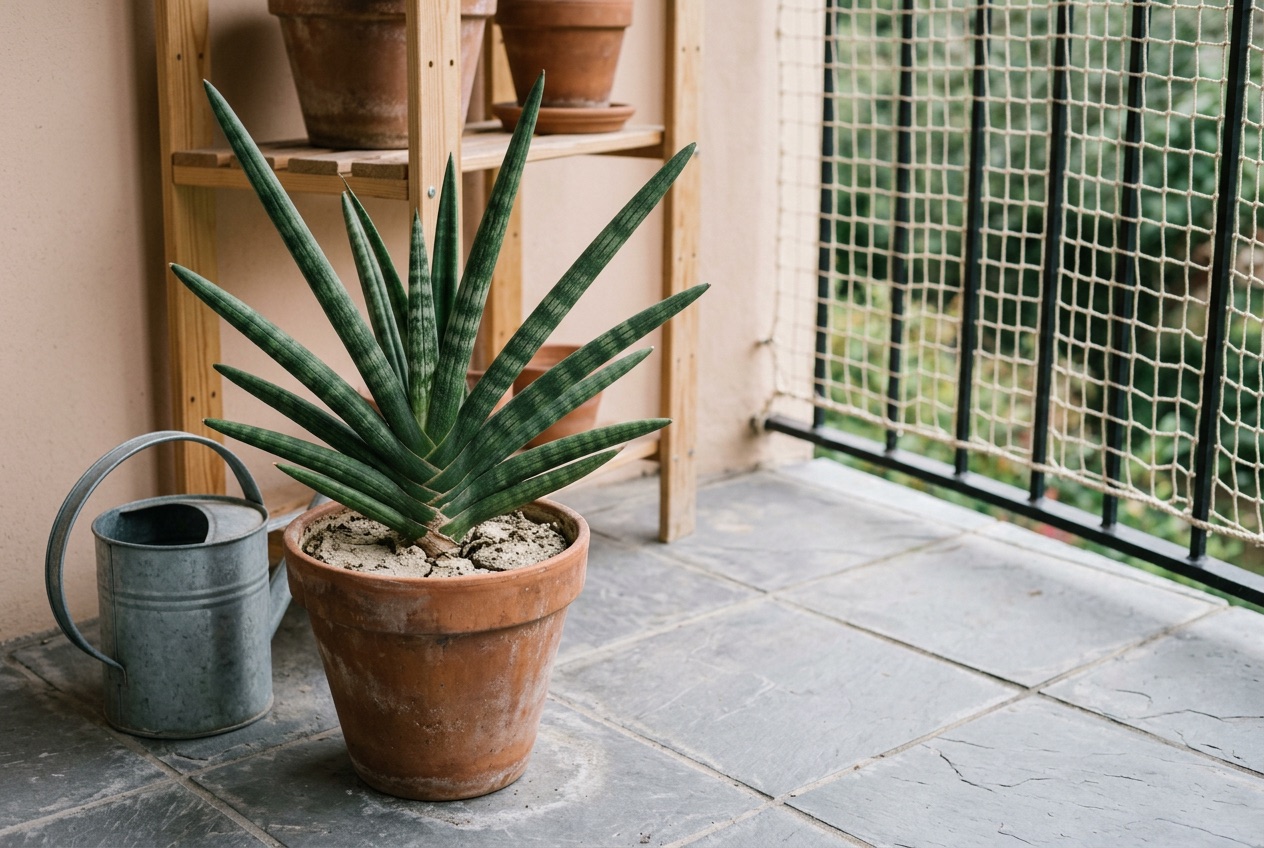
There is no correct number of days between waterings for a snake plant, and the confidence with which the internet supplies one should worry you.
Look at what the actual authorities say. The Missouri Botanical Garden rates it Water: Medium, Tolerate: Drought, and gives this as its complete guidance: "Water regularly during the growing season, with significantly reduced watering from fall to late winter." No interval. The Royal Horticultural Society is more direct about why — "Push your finger into the compost to check, rather than watering routinely."
That is the answer, and it is not evasion. Watering frequency is a function of light, temperature, pot size, pot material, soil mix and plant size. Change any one and the interval moves. A plant in a bright south window in July and the same plant in a north hallway in January are not on the same schedule, and no number covers both.
So this piece does two things: it gives you the one interval the literature will actually commit to, and it gives you the method that makes intervals unnecessary.
The one number anyone will commit to
NC State Extension states it plainly:
"In spring to autumn allow the soil to dry between waterings. In winter only water every one to two months."
That winter figure — every one to two months — is the only specific interval I can find from a source of that standing, and it is worth internalising because it is so far from what most people do. Between roughly November and February, a snake plant in an average heated room needs water somewhere between six and twelve times less often than the fortnightly habit most owners fall into.
For spring through autumn there is no equivalent number, from anyone, because there isn't one. Colorado State's PlantTalk gets as specific as anyone: water thoroughly, "then let dry slightly between waterings."
Why the plant is built this way
Dracaena trifasciata comes from hot, dry parts of west Africa. The RHS describes the group as "drought-tolerant, with fleshy, succulent leaves that are able to store water." The leaf is the reservoir. A snake plant that has gone a month without water is not in distress — it is spending down a supply it evolved to carry.
This is why the failure mode is so lopsided. Underwatering a snake plant is slow, visible and almost entirely reversible. Overwatering is fast, hidden and frequently fatal. Both NC State and the RHS name the same mechanism: "do not overwater, as the roots will rot" and "Overwatering sansevierias is a common cause of poor health, as the roots are likely to rot."
You are not trying to hit an optimum. You are trying to stay on the safe side of an asymmetric risk.
The method that replaces the schedule
Three checks, in increasing order of reliability.
The finger test. Push a finger into the soil to the second knuckle — about 5 cm. If you feel any moisture at that depth, do not water. This is the RHS's own recommendation and it is sufficient for most people.
The weight test. Better, and free. Lift the pot right after a thorough watering and again a fortnight later. The difference is water, and you will learn it in two cycles. A dry pot feels conspicuously light. Once you know the two extremes you can judge without touching the soil, and you avoid disturbing the surface every time.
The skewer. A wooden skewer pushed to the bottom of the pot and withdrawn comes out dark and damp where moisture remains. This is the only one of the three that tells you about the bottom of the pot, which is where root rot begins and where the finger test cannot reach.
The rule that follows from all three: water only when the pot is dry all the way down, then water thoroughly. Not a splash on a schedule — a full soak until water runs from the drainage holes, then nothing at all until dry again. Frequent small waterings keep the upper soil damp while the roots below sit in stale wet compost, which is the exact condition that kills these plants.
How to water it
Two specifics that almost nobody mentions, both from primary sources.
Do not pour water into the centre of the rosette. Missouri Botanical Garden says it, and Colorado State repeats it: "Care should be taken to not pour water into the center of the rosette." Water that collects where the leaves meet has nowhere to go and rots the crown from the inside. Aim at the soil, at the edge of the pot.
Top or bottom watering both work. Bottom watering — standing the pot in a few centimetres of water for twenty to thirty minutes until the surface darkens — has a real advantage here: it wets the whole profile without splashing the crown, and it does not leave the top layer damp. Top watering is faster and flushes accumulated mineral salts out through the drainage holes, which bottom watering never does. A reasonable compromise is to bottom water routinely and top water every third or fourth time to flush.
Either way, empty the saucer. A pot standing in water is a pot with no drainage.
What overwatering looks like

The diagnostic that matters: damage from overwatering starts at the base, not the tip.
- Leaves turn yellow at the base first, where they meet the soil, then brown
- The base becomes soft, water-soaked and slightly translucent, and the leaf loses its rigidity
- Leaves fall outward from the base while their upper halves are still firm and green
- A sour smell from the soil
- The soil surface stays dark and damp for many days after watering
By the time leaves flop, the roots have usually gone. Tip the plant out and look. Healthy roots are fine, wiry and rust-orange, branching densely; the thick pale cream-white organ they grow from is not a root at all but the rhizome — a horizontal, faintly segmented underground stem that throws up a fan of leaves at intervals along its length. Rotted roots are brown to black, soft and matted, and the outer sheath slides off between your fingers leaving a bare thread. A rotted rhizome is darkened, water-soaked and dented where you press it.

If it has reached that stage: cut away every soft root and any mushy rhizome with clean scissors, let the cut surfaces dry in air for a day, and repot into fresh, gritty, barely-moist mix. Do not water for a fortnight afterwards. A plant with some firm rhizome left will usually recover — the full rescue, step by step, goes further than this. One that is soft throughout will not, though healthy leaves can still be taken as cuttings.
What underwatering looks like
Slower, and much less alarming.

- Leaves wrinkle and crease lengthwise — the reservoir is being spent
- Edges curl inward
- Leaves lean rather than standing rigid
- Tips go brown, dry and papery
A wrinkled leaf will plump back out within a week or two of a thorough soak. A leaf that has already browned at the tip will not — that tissue is dead and stays dead, and no amount of correction grows it back. This is worth accepting early, because trying to fix a brown tip by watering more is how underwatered plants become overwatered ones.
How long can it go without water?
Longer than you think. In winter, NC State's one-to-two-month interval is the guide. In summer, a mature plant in a modest pot will sit for three to four weeks without complaint, and a fortnight is comfortably safe.
For a two-week holiday, do nothing. Water thoroughly before you leave, move it out of direct sun, and go. The snake plant is close to the only popular houseplant for which this is genuinely true, and the self-watering arrangements people rig up for it usually do more harm than the absence would have.
Water quality, and a claim worth being careful about
Fluoride is a real problem for some Dracaena, and this deserves a precise account rather than the confident one you will find elsewhere.
The Pacific Northwest Pest Management Handbooks establish the mechanism: many municipal water supplies are fluoridated at around 1 ppm, "use of this water for irrigation can result in toxicity symptoms on sensitive plants," fluoride is "an accumulative poison in plant foliage," and the classic symptom is "marginal and tip necrosis that spread inward."
Here is the careful part. The handbook's Dracaena tip burn entry names the sensitive species specifically: "Both Dracaena deremensis and D. fragrans (corn plant) are very sensitive to fluoride toxicity." It does not name D. trifasciata. Snake plant only joined this genus in 2017, and the fluoride literature predates that and concerns the classic foliage dracaenas.
So the honest position: fluoride tip burn is well documented in close relatives of the snake plant, and not, as far as I can establish, demonstrated in the snake plant itself. Treat it as a plausible and very cheap precaution rather than a proven cause. If your tips are browning and you are on fluoridated mains water, leaving water to stand overnight does nothing for fluoride — but rainwater, distilled or reverse-osmosis water costs little to try.
Two better-supported causes to rule out first, both from the same handbook: excessive drying between waterings "can lead to brown tips and margins, especially if fertilised too much," and accumulated fertiliser salts. Flush the pot thoroughly with plain water before blaming your tap.
Should you mist it?
No.
Misting raises humidity for a few minutes and achieves nothing that lasts. NC State notes the plant "tolerates low humidity" — it is from an arid habitat and has no unmet humidity requirement in a normal home. What misting does reliably is wet the crown and the leaf junctions, which is precisely where you do not want standing water.
If a plant near you needs humidity, it isn't this one.
The pot is part of the watering
An oversized pot is a watering problem disguised as a repotting decision. The RHS is explicit: a much larger pot "will contain a lot of spare compost, which will tend to stay damp after watering, encouraging root rot." Go up one size only.
Terracotta breathes and dries faster than plastic or glazed ceramic, which makes it more forgiving of a heavy hand — pot, light and feeding all pull on each other, and the care overview sets them side by side. And the mix matters more than the schedule: a free-draining cactus compost, or two parts loam-based compost to one part grit, will tolerate a mistake that ordinary potting soil will not.
The short version
- In winter, every one to two months. The only interval a serious source will state.
- In spring and summer, when the pot is dry all the way down — days elapsed is the wrong unit.
- Water thoroughly, then leave it entirely alone. Little and often is the failure pattern.
- Never into the centre of the rosette.
- Yellow and soft at the base means overwatered. Wrinkled and creased means thirsty. Only one of those is an emergency.
If you take one thing: this plant is far more likely to die of your attention than your neglect. When you are unsure whether to water it, the answer is almost always no.