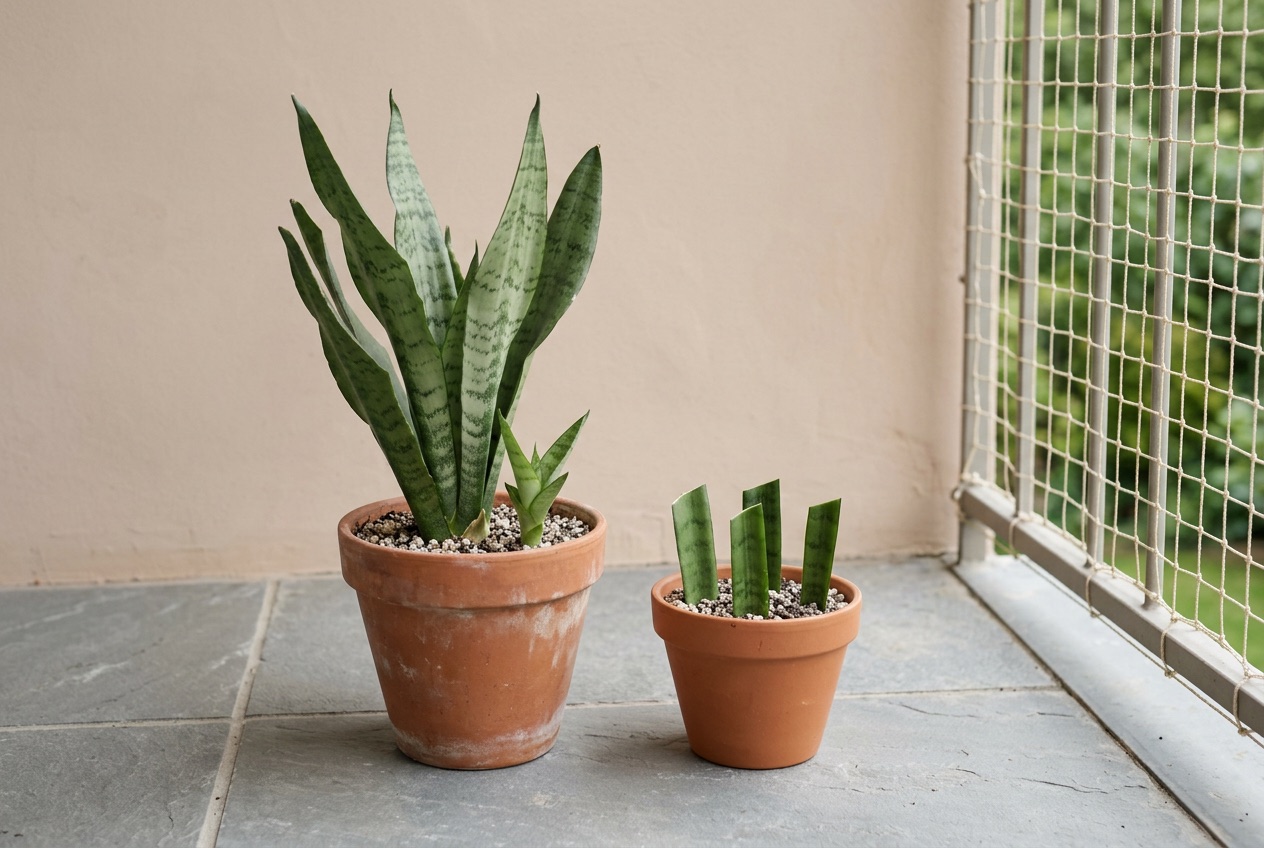
Snake plants propagate reliably through three methods: dividing pups (the fastest route to new plants), rooting leaf cuttings (the slowest but most productive), and separating rhizome sections (the middle ground). Division gives you a mature plant immediately; leaf cuttings take many months to root and many more to produce a pup; rhizome sections root faster than leaves but slower than established pups.
The choice depends on what you have to work with and how patient you are. If your plant has pups, division is the obvious path. If you only have leaves—from pruning, breakage, or a cutting someone gave you—you're committing to the long game.
What Snake Plant Pups Look Like and When to Separate Them
Pups emerge from the rhizome as small, upright shoots near the base of the mother plant. They start as tight cylinders a few centimetres tall and gradually unfurl into the characteristic sword shape. NC State Extension describes the plant's clumping growth habit: new shoots arise from the underground rhizome system, forming dense clusters over time.
You can separate pups once they've developed their own root system and reached a size where they can tolerate the shock of repotting. Smaller pups survive separation, but they're more vulnerable to rot and slower to establish. Waiting until they're more substantial gives you a plant that can resume growth more quickly.
To check if a pup is ready, gently brush soil away from its base. Every pup is joined to the parent rhizome — that connection is not the signal. What you are looking for is whether the pup has put out its own roots, growing down from its own base rather than running back along the rhizome. A pup with its own root system will survive separation. One that is still a fleshy shoot drawing everything from the parent will not, so leave it attached and check again later.
How to Divide Snake Plant Pups
Remove the entire plant from its pot and shake or rinse away enough soil to see the rhizome structure. The rhizome is the thick, horizontal stem that runs underground—pups and mature shoots both grow from it. RHS guidance on Sansevieria recommends division as the primary propagation method, noting that it preserves variegation (leaf cuttings from variegated cultivars revert to plain green).
Use a clean, sharp knife to cut through the rhizome between the pup and the mother plant. If the pup has already formed its own rhizome segment with roots, you can sometimes pull it free by hand, but cutting is cleaner and reduces tearing. Each division needs at least one growing point (the base where leaves emerge) and some roots.
Pot each division immediately in well-draining soil—a cactus mix or a blend with high porosity works well. Snake plants rot easily in moisture-retentive soil, especially when their root systems are small. Use a pot that's only slightly larger than the root mass; oversized pots hold too much water and slow establishment.
Water lightly after potting, then wait until the soil is completely dry before watering again. New divisions are more vulnerable to overwatering than established plants because they have fewer roots to take up moisture. Missouri Botanical Garden rates snake plant as drought-tolerant and recommends significantly reduced watering from fall to late winter—a principle that applies even more strictly to fresh divisions.
The Fastest Way to Propagate a Snake Plant
Division of pups is the fastest method by a wide margin. A separated pup with established roots resumes growth quickly and looks like a mature plant from day one. Leaf cuttings, by contrast, take many months just to develop roots, then many more months to produce their first pup.
If your plant has no pups and you need more plants quickly, you cannot shortcut the timeline — you are working with the plant's biology, and no source we trust publishes how long it takes. A leaf section has to form callus tissue, then root initials, then an entirely new growing point, before anything appears above the surface. That sequence is why it is slow.
The only variable you control is method. Leaf cuttings in perlite or a perlite-soil mix root faster than cuttings in water or pure soil, because perlite provides both moisture and aeration. Several Reddit users report faster rooting in perlite compared to water, though no published study quantifies the difference for Dracaena trifasciata specifically.
How to Propagate Snake Plant from Leaf Cuttings
Cut a healthy leaf at the base with a clean blade. You can propagate the entire leaf or cut it into sections—each section can produce roots and eventually a pup, so sectioning one leaf yields multiple plants. When cutting sections, make a straight cut at the top and a V-shaped or angled cut at the bottom. This marks polarity (snake plant cuttings only root from the basal end) and increases the rooting surface area.
Let the cut ends dry for a day or two until they form a dry, tan callus. This step is non-negotiable. Fresh cuts absorb water too quickly and rot before they can form roots. The callusing period allows the wound to seal and begin forming the tissue that will differentiate into roots.
After callusing, you have three options: soil, water, or perlite.
Soil propagation: Insert the basal end into barely moist cactus mix or a porous blend. Place in bright indirect light. Water sparingly—only when the soil is completely dry and the cutting feels light. Roots typically form over several weeks, but you won't see them unless you unpot the cutting. The first visible sign of success is a small pup emerging at the soil line, which growers often report takes several months.
Water propagation: Place the cutting in a jar with water covering the basal end. Change the water weekly to prevent bacterial growth. Roots appear as white, branching structures over the course of weeks to months. Once roots have developed sufficiently, pot the cutting in soil. Water-to-soil transitions sometimes fail because water roots are structurally different from soil roots—keep the soil barely moist for the first couple of weeks to ease the transition, then resume normal (infrequent) watering.
Perlite propagation: Fill a container with horticultural perlite and insert the cutting. Add water until the perlite is saturated but not submerged. Perlite holds moisture while providing air to the developing roots, which reduces rot risk compared to pure water and speeds rooting compared to soil. This method is under-documented in extension literature but widely reported as effective by growers. Roots appear over several weeks; pot in soil once they're well-developed.
How Long It Takes for Snake Plant Cuttings to Root
Leaf cuttings in water or perlite typically show roots over the course of several weeks to a few months under good conditions—bright indirect light, warm temperatures, and no bacterial contamination. Cuttings in soil take longer to show evidence of rooting because you can't see the roots forming; the first sign is often the pup, which appears many months after you pot the cutting.
No authoritative source publishes a precise timeline, because rooting speed varies with temperature, light, cutting size, and the plant's physiological state when you took the cutting. The RHS growing guide notes that leaf cuttings are slow to establish but doesn't quantify the duration. Reddit growers commonly report roots appearing after a few months and visible pups taking six months to a year or longer, which aligns with observed practice but isn't a measured figure.
Cuttings taken in spring and summer root faster than those taken in autumn and winter, because the plant's growth rate follows seasonal light and temperature cues. A cutting potted in autumn may sit dormant until spring before forming roots.
How to Propagate Snake Plant from Rhizome Sections
If you're dividing a mature plant and find sections of rhizome with no attached leaves, you can propagate those as well. Cut the rhizome into sections, ensuring each piece has at least one node (the bump where a leaf or pup would emerge). Let the cuts callus for a day or two, then plant them horizontally or at an angle in cactus mix.
Rhizome sections produce pups faster than leaf cuttings—typically within a few months—because the rhizome already contains the meristematic tissue needed to generate new shoots. This method is less common than leaf cuttings simply because most people don't have spare rhizome sections lying around, but it's useful when repotting a large, root-bound plant.
Variegated Cultivars Revert from Leaf Cuttings
Leaf cuttings from variegated cultivars (like Dracaena trifasciata 'Laurentii', with yellow leaf margins) revert to solid green. The pup that emerges from a variegated leaf cutting will be plain green, matching the wild type. This happens because the variegation in most snake plant cultivars is a chimeral mutation—the yellow tissue exists only in specific cell layers, and those layers aren't represented in the leaf tissue that forms the new pup.
RHS guidance explicitly notes this: "Leaf cuttings will not come true from variegated forms." To preserve variegation, you must propagate by division, separating pups that are already variegated. The pup inherits the full chimeral structure because it grows from the rhizome, which contains all cell layers.
This is one of the few cases where the slower method (waiting for pups) is actually the only method that works for the desired outcome.
What to Do If Your Snake Plant Isn't Producing Pups
Snake plants produce pups in response to root crowding and adequate light. A plant in a too-large pot with loose soil may grow slowly and never produce offsets, because it's investing energy in root expansion rather than reproduction. NC State Extension describes the plant as tolerant of low light but notes that growth is slower in dim conditions.
To encourage pupping, keep the plant slightly root-bound and provide bright indirect light. A pot that's only slightly wider than the root ball creates the crowding that triggers offset production. Direct sun isn't necessary and can scorch leaves, but a spot near an east or west window will produce more pups than a dim corner.
Age also matters. Young plants and newly rooted cuttings focus on establishing their own root systems before producing offsets. A plant grown from a leaf cutting may take years to produce its first pup, while a divided pup may produce its own offsets much sooner.
If your plant is mature, root-bound, and in good light but still not pupping, the most common cause is overwatering. Constantly moist soil suppresses root growth and keeps the plant in a survival mode where it doesn't reproduce. Let the soil dry completely between waterings—the pot should feel light when you lift it, and the top several centimetres of soil should be dry to the touch.
Rooting Pups and Cuttings in Water
Yes, but it's unnecessary and slightly riskier than potting them directly in soil. Pups separated from the mother plant already have roots; they don't need a water-rooting phase. Putting a rooted pup in water delays establishment and introduces the water-to-soil transition problem, where roots adapted to constant moisture struggle when moved to drier soil.
If a pup breaks off accidentally and has no roots, treat it like a leaf cutting: let the wound callus for a day or two, then root it in water, perlite, or soil. But if you're deliberately dividing pups, pot them in soil immediately after separation.
Deciding Whether to Separate a Pup at All
You can separate pups any time they're large enough to survive on their own—generally when they have visible roots and sufficient size to tolerate the shock. There's no seasonal requirement; snake plants tolerate division year-round, though spring and summer divisions establish faster because the plant is actively growing.
The decision to separate or leave pups attached is aesthetic and practical. Leaving pups in place creates a dense, multi-crowned clump that fills the pot and eventually requires a larger container. Separating them gives you multiple plants and keeps the mother plant at a manageable size.
If you want a full, bushy look, leave the pups. If you want to share plants, control size, or prevent the pot from cracking under rhizome pressure (a real problem with ceramic pots—the expanding rhizome can split them), separate the pups.
Common Mistakes When Propagating Snake Plants
Watering fresh cuttings on a schedule is the most common error, and it is the same mistake that kills established plants: days elapsed is the wrong unit. Cuttings have minimal or no roots and can't take up water quickly. Soil that stays moist for more than a few days will rot the cutting before roots form. Water only when the soil is completely dry and the cutting feels light.
Skipping the callusing step leads to rot. Fresh cuts are open wounds that absorb water faster than the plant can process it. The drying period is not optional.
Using pots that are too large for the cutting or division creates a reservoir of moisture the plant can't use. A cutting with no roots needs a pot barely larger than the cutting itself. You can pot up to a larger container once the plant is established and growing.
Cutting variegated leaves expecting variegated pups results in disappointment. This isn't a mistake in technique; it's a misunderstanding of how variegation works. If you want variegated plants, divide existing variegated pups.
Expecting fast results from leaf cuttings leads people to assume the cutting has failed and discard it prematurely. Leaf cuttings are viable for many months with no visible progress. If the cutting is still firm and the cut end is dry (not mushy or black), it's alive and working. Roots and pups will appear eventually, but "eventually" can mean the better part of a year.
Tools and Materials You Need
- A clean, sharp knife or pruning shears (sterilise with rubbing alcohol between cuts)
- Well-draining potting mix (cactus mix, or a porous blend with high drainage)
- Small pots with drainage holes (sized appropriately for cuttings and divisions)
- Optional: horticultural perlite for perlite propagation
- Optional: rooting hormone powder (not necessary but may speed rooting slightly)
Snake plants root readily without rooting hormone, but if you have it on hand, dipping the cut end before potting can marginally improve success rates. No published study quantifies the effect for Dracaena trifasciata, but rooting hormones (typically indole-3-butyric acid) are proven to accelerate adventitious root formation in a wide range of species.
What Happens After You Pot a Cutting or Division
For the first several weeks, nothing visible happens. The plant is forming new roots or repairing damaged ones. During this period, keep the soil on the dry side and resist the urge to check for roots by unpotting the plant (which damages fragile new roots).
Leaf cuttings will sit unchanged for months. The first sign of success is either visible roots (if propagating in water or clear perlite) or a small pup emerging at the base. That pup will grow slowly at first—a few centimetres over several months—then accelerate once it's established.
Divisions resume growth faster. A separated pup with intact roots will produce a new leaf within weeks to a couple of months if conditions are good. Growth is slow in winter and faster in spring and summer.
Once the plant is visibly growing—producing new leaves or elongating existing ones—you can resume normal care. Water when the soil is completely dry, provide bright indirect light, and fertilise sparingly during the growing season (spring and summer) if you fertilise at all. Snake plants are light feeders; Missouri Botanical Garden notes they tolerate low fertility and don't require regular feeding.
Propagation is where snake plant's reputation for indestructibility shows its limit. The plant tolerates neglect once established, but cuttings and fresh divisions need attention to moisture, light, and pot size. The process is slow, but it's reliable if you match your expectations to the method. Division gives you mature plants immediately. Leaf cuttings give you many plants eventually. Choose based on what you have and how long you're willing to wait.